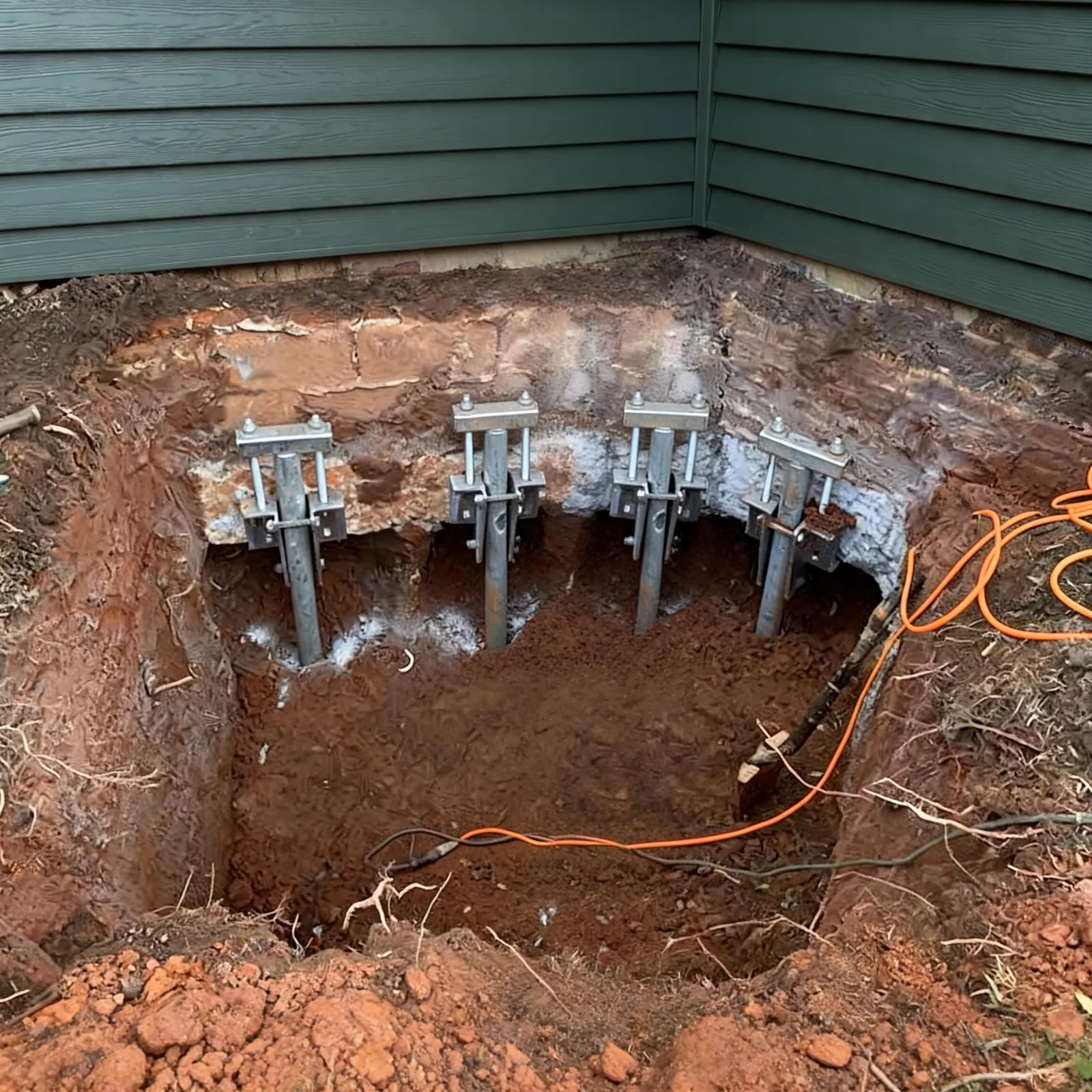
Foundation Repair & Piering
Foundation Repair & Piering in Athens, GA
Foundation repair with piers, wall bracing and crack repair for sloping floors and cracked walls, by licensed and insured contractors.
Cracks, Sticking Doors and Sloping Floors: What You May See
Many hairline cracks are only cosmetic. Others point to movement that foundation repair may address.
Only an inspection shows which one you have. Here is what you may see and what it can mean.
- Stair-step cracks in brick or block. They can follow movement in the footing under that wall. They can also come from old settling that stopped long ago.
- A horizontal crack in a block or crawl space wall. It can mean the wall is being pushed inward. Water pressure is one possible cause, so the drainage around the wall matters too.
- Doors and windows that stick or will not latch. The frame may have shifted. Humidity can cause this as well, so it is a reason to look, not a verdict.
- Gaps between a wall and the ceiling, floor or trim. A section of the house may have dropped. A level survey shows how far.
- Sloping or bouncy floors. They can mean a sagging beam or pier, or a footing that has moved. They can also mean a framing problem that piers will not fix.
- A porch, chimney or garage slab pulling away from the house. The two parts may be moving at different rates. An inspection checks whether the main foundation is involved.
- Cracks in a slab floor that keep growing. Some slab cracks stay small. Cracks that widen or show a height change between sides call for a closer look.
Not sure what you are seeing? A foundation inspection and structural evaluation looks at the whole picture.
Foundation Repair in Athens, GA: Piers, Braces and Crack Sealing
Foundation repair covers several methods. Each solves a different problem, and a contractor picks one only after seeing the cause.
| Method | What it does | Fits when | Limits |
|---|---|---|---|
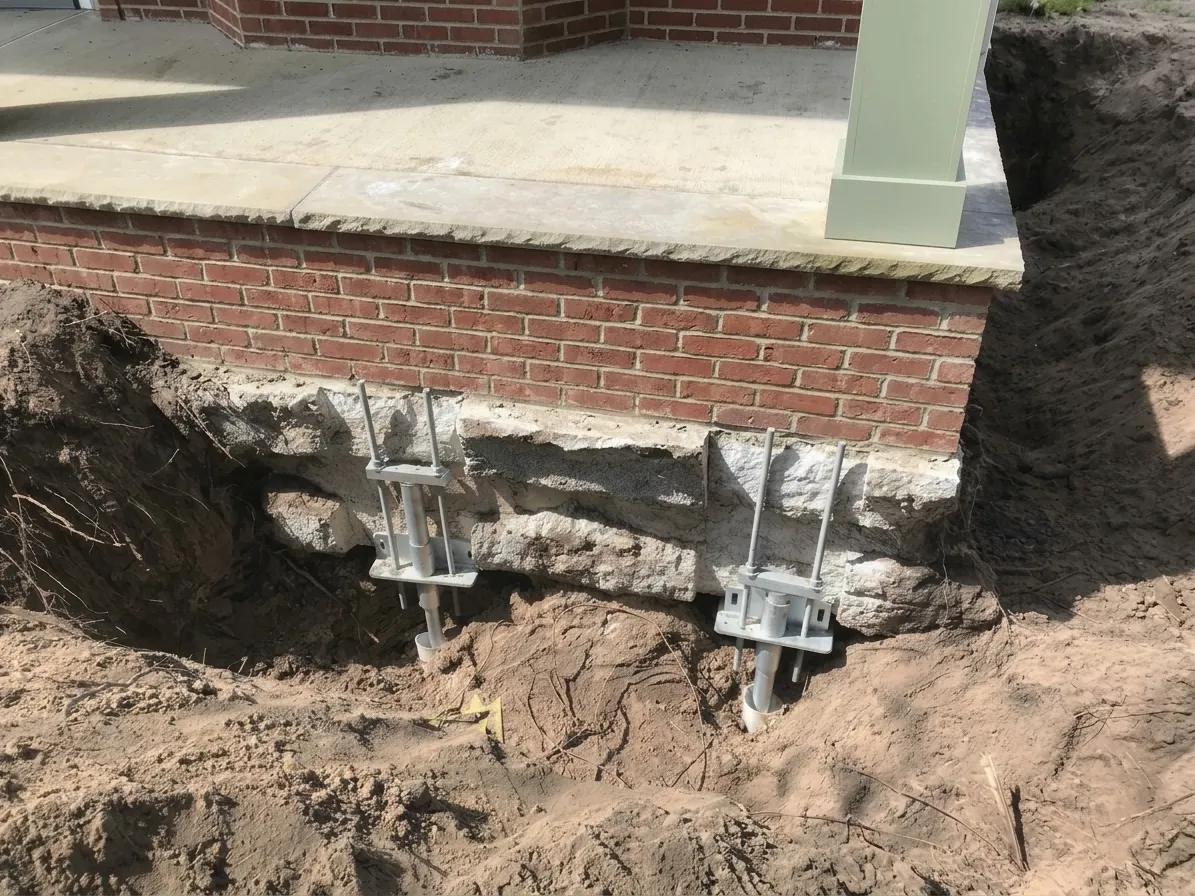
| Helical pier | A steel shaft with screw plates is turned into the ground until it reaches firm soil, then the footing is carried on a bracket. | Light to medium loads, or when you want to know the load the pier is carrying as it goes in. | Needs firm ground within reach. Access for the machine can be tight. |
| Push pier | A steel pipe is driven down hydraulically, using the weight of the structure as resistance, to a firm layer. | Heavier structures such as brick houses with solid footings above. | Needs enough structure weight to drive. Does not suit every footing. |
| Wall brace or carbon fiber strap | A brace, anchor or fiber strap holds a bowing block or crawl space wall in place. | Walls pushed inward but still straight enough to hold. | Holds the wall. It does not lift the footing and does not remove the water pressure. |
| Crack sealing | Epoxy or polyurethane is injected into a crack to close it. | Stable cracks that let in water or air. | Closes a crack. It does not stop movement that caused it. |
How a Pier Job Goes, From First Look to Final Check
- Tell us what you see. Describe the cracks, doors or floors you want checked for foundation repair, and where they are. Send photos if you have them.
- Look at your location. A licensed and insured contractor visits and checks the cracks, the level of floors and the water around the building.
- Find the cause. Movement can come from the footing, the ground or the water. The contractor works out which one before choosing a method.
- Plan and do the repair. You get a written scope with the method and where it goes. The crew then does the foundation repair: it sets piers, braces or seals as planned.
- Check the result. The contractor rechecks doors, cracks and floor level, cleans up, and tells you if drainage work should follow.
What Moves the Price of Pier and Wall Work
No two jobs cost the same. These are the things that move the price. Ranges are on our foundation repair cost page.
- How many piers or braces the job needs.
- How deep the firm layer is under each spot.
- How easy it is to reach the work: a crawl space, a tight side yard, a deck or landscaping in the way.
- Whether the goal is to stabilize the structure or also to lift it back toward level.
- Which foundation repair method fits: helical pier, push pier, wall brace or crack sealing.
- Repairs to finishes afterward, such as drywall, trim or brick.
- Water fixes that the inspection says should come with the repair.
Red Clay, Saprolite and Older Housing Around Athens
These facts for foundation repair in Athens come from public sources. They describe the area, not your property. An inspection shows what is behind any one crack.
- The USGS Ground Water Atlas (HA 730-G) says the Piedmont is underlain by crystalline rock covered by regolith. Saprolite is the largest part of that regolith, it is up to about 150 feet thick in places, and its thickness is extremely variable. Pier depth is set on site for that reason.
- A sample of grid points from the USDA NRCS soil survey, queried 2026-10-09, shows low shrink-swell at every natural point in Clarke, Oconee, Jackson and Barrow counties. That is 104, 92, 107 and 103 points. The sample describes the soil type at a point, not any lot.
- The NRCS series descriptions for Cecil and Madison, two soils common in these samples, list shrink-swell potential as low, with a red clay subsoil over saprolite.
- The Census ACS 2020-2024 5-year estimates show a median year built of 1987 for Clarke County, with 39.5% of housing units built before 1980. Oconee, Jackson and Barrow counties show median years of 1998 to 2002. These are estimates for all housing units and do not say what kind of foundation they have.
Foundation Repair & Piering Questions in Athens, GA
How deep do piers go in Athens, GA?
The depth is set on site, not by a table. The USGS says the thickness of the weathered layer over rock in the Piedmont is extremely variable. The contractor finds firm ground at your location and plans from that.
Does Athens clay swell and crack a foundation?
The soil survey sample shows low shrink-swell at every natural point in Clarke, Oconee, Jackson and Barrow counties. The sample describes soil types at points, not your lot. Only an inspection shows what moved your foundation.
Will piers lift my floors back to level?
Sometimes they lift some of the drop, and sometimes they only stop further movement. It depends on the footing, the framing and the soil. The contractor explains which one to expect before work starts.
Do I need drainage work as well as piers?
Water near a foundation may add to movement, so the inspection looks at it. If water is part of the problem, the contractor may suggest the fixes on our drainage and water control page alongside the foundation repair.
Does my house age change the repair in Athens?
Age alone does not say what is wrong. The Census shows an older housing stock in Clarke County than in nearby counties, but it gives no foundation type. A foundation inspection shows what you have and what it needs.
Contact Us Today for a Free Estimate
Need foundation repair in Athens? Tell us what you see, from cracks to sloping floors. A licensed and insured contractor will look it over and give you a free estimate.