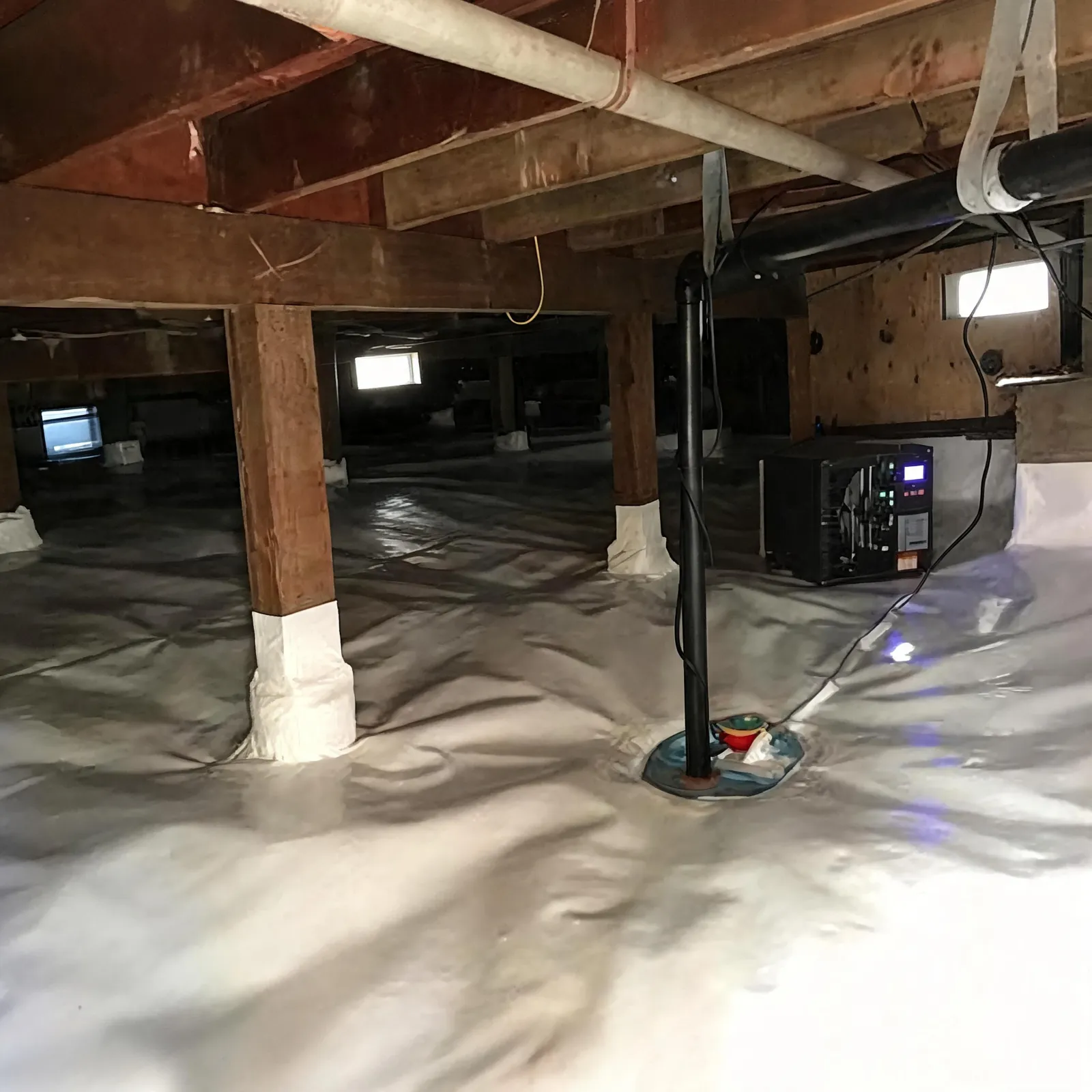
Sump Pumps & Interior Drainage
Sump Pumps & Interior Drainage in Athens, GA
Sump pump installation and interior drains for water that gets into low rooms and crawl spaces in Athens and nearby towns.
Signs Water Is Reaching Below the Floor Line
Water inside a building often shows up in low spots first. These are things you can see. Each has more than one possible cause, and only an inspection confirms which.
- Damp patches or puddles on a basement or low-room floor after rain. Water may be coming up through the floor edge or a crack.
- Standing water or wet soil in a crawl space. Ground water may be collecting under the building. See our crawl space encapsulation page for the moisture side.
- White mineral stains or water lines low on a wall. Water may have reached the wall and dried more than once.
- A musty smell that gets stronger after wet weather. Moisture may be collecting somewhere you cannot see.
- Peeling paint or swollen trim near the floor. Damp air or splashes may be reaching the wall base.
- An existing sump pump that runs again and again, or makes new noises. It may be working hard, or a part may be worn.
- A pit that fills but a pump that never starts. The switch, the power or the pump may have failed.
Look outside too. Roof water that lands at the wall can cause the same signs, and our drainage and water control page covers that.
Sump Pump Installation and Other Ways to Handle Indoor Water in Athens
Sump pumps are one tool among several. Often the first step is to stop water outside, then add an interior system where water still gets in.
| Option | What it does | Fits when | Limits |
|---|---|---|---|
| Gutters, downspouts and grading | Keeps roof and yard water from reaching the wall. | Water lands at the wall or the ground slopes toward it. | Does not help water that already collects under the floor. |
| Sump pit and pump | A pit collects water, and a pump lifts it out through a pipe. | Water gathers below the floor line and cannot drain away by gravity. | Needs power and upkeep. A pump can wear out. |
| Interior drain along the wall base | Pipe set under the floor edge or along the crawl space edge carries water to the pit. | Water seeps in at many points along a wall. | Means opening the floor in a finished room. It handles water, not the cause outside. |
| Discharge line and outlet | Carries pumped water away from the building. | Always, with any pump. | Needs a place where water can run off and not return to the wall. |
| Battery backup | Runs a second pump when power fails. | Storms may cut power while the ground is wet. | The battery runs for a limited time and needs checks. |
| Vapor barrier in a crawl space | Covers the ground to slow moisture rising into the space. | Damp air is the issue, not standing water. | Does not remove water that pools. See crawl space encapsulation and vapor barriers. |
How a Sump Pump Job Goes, Step by Step
- Find where the water enters. The contractor looks at the floor, walls, crawl space and the ground outside, and asks when the water shows up.
- Check the outside first. Gutters, downspouts and grading are reviewed. If they cause the problem, fixing them may come before any pump.
- Plan the pit, drain and outlet. You get a plain plan that shows where water will collect, where the pump sits and where the pipe sends the water.
- Install the system. The crew sets the pit, any interior drain pipe and the pump, then connects the discharge line and the power.
- Test and explain. The contractor fills the pit to run the pump, shows you the switch, and explains what to check each season.
What Moves the Price of a Pump and Drain Job
The price depends on the building and the plan. These things move it.
- Whether the system is a single pit and pump or includes an interior drain run.
- How much floor must be opened, and whether it is concrete, a finished surface or bare ground.
- The length and route of the discharge line to a place where water can run off.
- The pump type and size, and whether a battery backup or a second pump is added.
- Access to the work area, such as a tight crawl space or a finished room.
- Electrical work needed to power the pump safely.
- Outside fixes added to the plan, such as gutters or grading.
The estimate visit sets the scope. Ask for it in writing. Request a free estimate to start.
Rain, Rivers and Mapped Flood Zones Around Athens
The sources below describe water in the Athens area. None of them says what is happening at your address.
- Rain. NOAA 1991-2020 climate normals for the Athens Ben Epps Airport station list 48.95 inches of rain a year, with 15.0 days a year at an inch or more. That one station stands in for four counties.
- Storm washouts. The Red & Black and FOX 5 Atlanta reported on Jan. 4, 2023 that heavy rain damaged Olympic Drive and Charlie Bolton Road in Athens-Clarke. A county official said aging infrastructure played a role.
- River warnings. Grady Newsource (Feb. 27, 2013) and WGAU radio news (Sept. 18, 2020) reported Oconee River flood warnings near Penfield.
- Mapped flood zones. A FEMA National Flood Hazard Layer point sample, queried Oct. 9, 2026, found points inside a Special Flood Hazard Area. The counts were Clarke 9 of 106, Oconee 5 of 93, Jackson 9 of 113 and Barrow 7 of 103. A point outside a zone does not prove a place stays dry.
The USDA soil survey sample shows low swelling potential at every natural point in the four counties. For this service, the focus is water, not swelling soil.
Sump Pumps & Interior Drainage Questions in Athens, GA
Does every building in Athens, GA need a sump pump?
No. A pump only helps where water collects below the floor line. Gutters and grading fix many cases, and an inspection shows whether a pump is the right fix.
Will my pump still run in a storm outage near Athens?
A standard pump stops without power, but a battery backup can run it for a limited time. Flagpole reported about 3,500 Athens customers without power on Sept. 27, 2024.
Is a sump pump the same as an interior drain?
No. An interior drain is pipe that collects water along a wall or floor edge. The sump pump lifts that water out of the pit and away from the building.
Where does the water from a sump pump go?
Out through a discharge line to a spot where it can run off and not return to the wall. The route depends on your lot, so the contractor plans it with you.
How do I know if I need sump pump installation or a crawl space fix?
A pump fits standing or collecting water. If the issue is damp air, a vapor barrier may fit better. Only an inspection shows which, and the crawl space page explains more.
Contact Us Today for a Free Estimate
Have water below the floor line or a pump that keeps failing? Tell us what you see. A licensed and insured contractor will look it over and give you a free estimate.